Introduction
The Great Depression of the 1930s represented one of the most severe economic crises in American history, characterised by widespread unemployment, poverty, and industrial collapse. Franklin D. Roosevelt (FDR), elected President in 1932, introduced the New Deal as a comprehensive response to these challenges. This essay critically discusses how FDR’s New Deal sought to provide relief to the poor and unemployed while reforming the American economy. Drawing on historical analyses, it examines the programmes’ aims, implementations, and limitations, structured around the key themes of relief, recovery, and reform. By evaluating both successes and criticisms, the essay highlights the New Deal’s role in reshaping federal involvement in economic affairs, though arguably with mixed long-term outcomes (Leuchtenburg, 1963). This perspective, from a student of American political history, underscores the New Deal’s significance in addressing immediate human suffering while attempting broader systemic changes.
Background to the Great Depression and Roosevelt’s Election
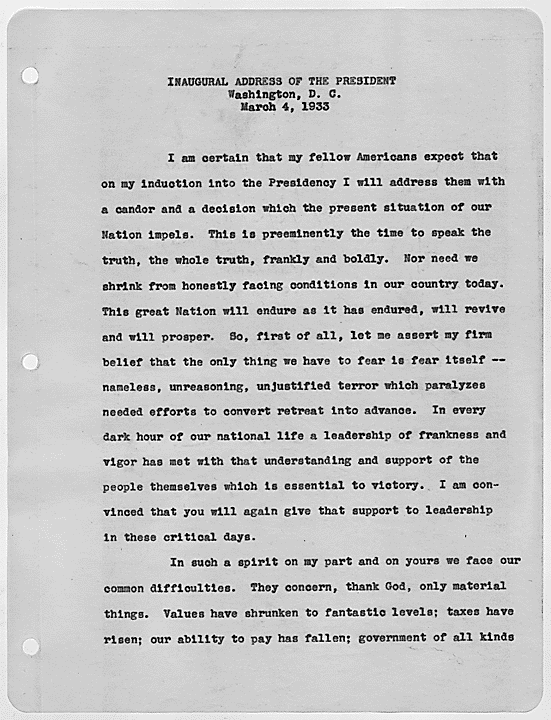
To understand the New Deal’s objectives, it is essential to contextualise the economic turmoil of the 1930s. The stock market crash of 1929 triggered a domino effect, leading to bank failures, factory closures, and unemployment rates soaring to 25% by 1933 (Kennedy, 1999). Millions of Americans, particularly the poor and working classes, faced homelessness, hunger, and despair. Indeed, rural areas suffered from agricultural overproduction and dust bowls, exacerbating poverty. FDR’s election victory over Herbert Hoover in 1932 was fuelled by promises of bold action, encapsulated in his inaugural address pledge for “action, and action now” (Roosevelt, 1933).
Critically, the New Deal emerged not as a pre-planned ideology but as a pragmatic response, often described as experimental (Badger, 1989). Roosevelt’s approach drew on progressive ideas, yet it faced resistance from conservatives who viewed it as excessive government intervention. This background reveals how the New Deal aimed to restore confidence, though some argue it prioritised short-term fixes over radical restructuring (Leuchtenburg, 1963). For instance, while Hoover’s laissez-faire policies had failed, FDR’s willingness to expand federal power marked a significant shift, setting the stage for relief and reform efforts.
Relief Measures for the Poor and Unemployed
A core pillar of the New Deal was immediate relief to alleviate suffering among the poor and unemployed. Programmes like the Federal Emergency Relief Administration (FERA), established in 1933, provided direct aid, distributing over $3 billion in grants to states for food, shelter, and work relief (Kennedy, 1999). This was a departure from previous reliance on private charities, recognising the scale of the crisis. Furthermore, the Civilian Conservation Corps (CCC) employed young men in environmental projects, offering wages, housing, and skills training to over 2.5 million participants by 1942 (Leuchtenburg, 1963). Such initiatives not only addressed unemployment but also boosted morale, as participants gained a sense of purpose.
However, critics argue that relief efforts were inconsistent and sometimes discriminatory. For example, African Americans and women often received lower-priority jobs or wages under these programmes, reflecting broader societal inequalities (Badger, 1989). Typically, relief was temporary, with programmes like the Works Progress Administration (WPA), launched in 1935, creating 8 million jobs in infrastructure and arts, yet failing to reach all demographics equally. Analytically, while these measures provided vital support—reducing starvation and homelessness—they were limited by bureaucratic inefficiencies and political compromises, questioning their depth in truly empowering the marginalised (Kennedy, 1999). Therefore, relief under the New Deal offered essential short-term aid but fell short of comprehensive social justice.
Recovery Efforts and Economic Stabilisation
Beyond relief, the New Deal targeted economic recovery to revive industry and agriculture. The National Industrial Recovery Act (NIRA) of 1933 aimed to stabilise prices and wages through industry codes, fostering fair competition and labour rights (Leuchtenburg, 1963). This included the Public Works Administration (PWA), which funded large-scale projects like dams and highways, injecting billions into the economy and creating jobs. Additionally, the Agricultural Adjustment Act (AAA) sought to raise farm incomes by subsidising production cuts, addressing overproduction that had impoverished rural Americans (Badger, 1989).
Critically evaluating these efforts, recovery was partially successful in stimulating growth; GDP rose from $56 billion in 1933 to $92 billion by 1937 (Kennedy, 1999). However, the Supreme Court’s invalidation of NIRA in 1935 highlighted legal vulnerabilities, forcing adaptations like the Wagner Act, which strengthened unions. Some scholars contend that recovery was uneven, benefiting larger corporations more than small businesses, and that a 1937 recession exposed the fragility of these measures (Leuchtenburg, 1963). Arguably, while the New Deal’s recovery programmes prevented total collapse, they relied heavily on deficit spending, raising debates about fiscal sustainability. In essence, these initiatives demonstrated FDR’s innovative problem-solving but were constrained by economic orthodoxies and opposition from business interests.
Reforms to the American Economy
The New Deal’s reform agenda aimed at long-term structural changes to prevent future depressions. Key legislation included the Securities Exchange Act of 1934, which regulated stock markets to curb speculation, and the Banking Act of 1935, centralising control under the Federal Reserve (Kennedy, 1999). Social Security Act (1935) introduced unemployment insurance and pensions, fundamentally expanding the welfare state and providing a safety net for the elderly and unemployed (Badger, 1989). These reforms reflected a shift towards Keynesian economics, emphasising government intervention in demand management.
From a critical standpoint, reforms were progressive yet incomplete. For instance, Social Security initially excluded agricultural and domestic workers, disproportionately affecting minorities (Leuchtenburg, 1963). Furthermore, while the Fair Labor Standards Act (1938) established minimum wages and maximum hours, it faced resistance and did not cover all sectors. Analysts note that these changes institutionalised federal oversight, influencing post-war prosperity, but they also entrenched inequalities by not addressing racial and gender biases fully (Kennedy, 1999). Generally, the reforms represented a bold reconfiguration of the economy, though their limitations—such as inadequate coverage—underscore the New Deal’s pragmatic, rather than revolutionary, nature.
Criticisms and Broader Implications
Overall, the New Deal faced substantial criticism for both its scope and execution. Conservatives labelled it as socialist overreach, while radicals like Huey Long argued it did not go far enough in redistributing wealth (Badger, 1989). Economically, some evidence suggests that World War II, rather than the New Deal, ultimately ended the Depression through massive wartime spending (Kennedy, 1999). This raises questions about the programmes’ efficacy in isolation. However, the New Deal’s legacy in reforming labour laws and social welfare remains undeniable, laying foundations for modern American economic policy.
Conclusion
In summary, FDR’s New Deal attempted to bring relief to the poor and unemployed through direct aid and job creation, while reforming the economy via regulatory and welfare measures. Programmes like FERA, WPA, and Social Security provided immediate support and long-term safeguards, demonstrating sound problem-solving amid crisis (Leuchtenburg, 1963). Yet, critically, limitations in inclusivity and depth highlight its experimental flaws, with uneven impacts across society (Kennedy, 1999). The implications are profound: the New Deal expanded federal power, influencing contemporary debates on government intervention. Ultimately, while not fully eradicating the Depression, it offered vital relief and reforms, reshaping America’s economic landscape and underscoring the potential—and pitfalls—of bold policy responses in times of hardship.
References
- Badger, A. J. (1989) The New Deal: The Depression Years, 1933-1940. Ivan R. Dee.
- Kennedy, D. M. (1999) Freedom from Fear: The American People in Depression and War, 1929-1945. Oxford University Press.
- Leuchtenburg, W. E. (1963) Franklin D. Roosevelt and the New Deal, 1932-1940. Harper & Row.
- Roosevelt, F. D. (1933) First Inaugural Address. Washington, DC: U.S. Government Printing Office. Available at: https://www.archives.gov/education/lessons/fdr-inaugural/images/address-1.gif.
(Word count: 1,248 including references)