
Abstract
This seminar paper examines the physical security design for a panel apartment building in Mladá Boleslav, Czech Republic, as part of a security management study. It analyses the current security setup, identifies vulnerabilities, and proposes practical measures to enhance protection. Key elements include technical and regime-based interventions, an economic analysis, and potential integration with centralised security services. The focus is on practical application, aiming to mitigate risks such as unauthorised entry and theft. Through a model intrusion scenario, the paper demonstrates potential threats and evaluates the effectiveness of proposed solutions. Overall, the recommendations aim to improve resident safety while considering cost implications, drawing on established security principles.
Introduction
In the context of security management studies, the design of physical security for residential buildings is crucial for protecting inhabitants and property from threats like burglary and vandalism. This paper focuses on a typical panel apartment building in Mladá Boleslav, a city in the Czech Republic known for its industrial heritage and growing urban population. The analysis is practically oriented, emphasising real-world application rather than extensive theoretical frameworks. It begins with a description of the object and its topology, followed by an assessment of existing security measures and identification of risks. A model intrusion scenario illustrates potential vulnerabilities, leading to proposals for technical and regime measures. An economic analysis, integration options with centralised protection, and effectiveness evaluation round out the discussion. The purpose is to provide a comprehensive, actionable security enhancement plan that balances efficacy and feasibility, informed by general principles of physical security (Fennelly, 2016). By addressing these aspects, the paper contributes to understanding how security management can be applied in everyday residential settings, particularly in medium-sized European cities where urban density increases vulnerability to crime.
Description of the Object
The analysed object is a multi-storey panel apartment building located in Mladá Boleslav, representative of post-war socialist-era constructions common in Central Europe. This building comprises approximately eight above-ground floors, housing multiple residential units. Access to the building is primarily through a shared main entrance, which leads to internal common areas. Additional features include basement storage spaces and an outdoor parking area in front of the building. Entry involves ascending stairs to the main doors, followed by internal doors opening into a communal hallway. The specific apartment under focus is situated on the second above-ground floor, featuring a layout that includes a children’s room, parents’ bedroom, living room, kitchen, separate bathroom, and separate toilet. Such structures are typical in Czech urban environments, where panel buildings (known as ‘paneláky’) accommodate a significant portion of the population (Czech Statistical Office, 2021). The building’s design prioritises functionality but often lacks modern security integrations, making it susceptible to external threats. This description sets the foundation for evaluating security needs, considering both the building’s communal spaces and individual units.
Topology of the Object
Understanding the topology of the apartment building is essential for mapping movement patterns and potential entry points. The layout begins externally with the parking area, connected to a sidewalk leading to the entrance stairs. These stairs provide access to the main entrance doors, which open into the building’s internal hallway. From there, residents can proceed via stairs or an elevator to upper floors, navigating through floor-specific corridors to reach individual apartment doors. Basement areas are accessible from the internal hallway, typically via separate stairs or doors, and include storage compartments for residents. Common corridors on each floor facilitate movement between apartments, while shared spaces like the entrance hall serve as hubs for daily traffic. This topology highlights multiple transition points where unauthorised access could occur, such as from the parking lot to the entrance or within basement areas. In security terms, these pathways represent critical zones for monitoring, as they enable the flow of people and potentially intruders (Garcia, 2007). The structure’s linear progression from external to internal spaces underscores the need for layered security to control access at each stage.
Analysis of Current Security
The current security measures in the apartment building are primarily mechanical and basic, reflecting older construction standards. Main entrance doors and apartment doors are equipped with standard mechanical locks, which provide a fundamental barrier but lack advanced features. There is no camera surveillance system installed, leaving common areas unmonitored. Similarly, electronic access control systems, such as key cards or biometrics, are absent, allowing unrestricted entry once the main doors are opened. Alarm systems are not present in communal or individual spaces, and basement areas rely solely on simple locks for storage units. This setup is common in many Czech panel buildings, where security has historically been minimal due to cost constraints and lower perceived threats in the post-communist era (Fennelly, 2016). However, this analysis reveals a reliance on passive measures, which are insufficient against determined intruders. The absence of active monitoring and electronic deterrents contributes to a reactive rather than proactive security posture, potentially exacerbating risks in an urban setting like Mladá Boleslav.
Identification of Security Risks
Several key security risks emerge from the analysis, primarily stemming from inadequate controls and monitoring. Uncontrolled access to the building allows strangers to enter easily, especially during peak hours when residents come and go. The lack of cameras means no visual deterrence or recording of activities, increasing the likelihood of undetected intrusions. Basement storage areas are particularly vulnerable, with weak locks that can be forced or picked. Overall, there is low oversight of movement within the building, enabling loitering or unauthorised exploration. These risks are heightened in Mladá Boleslav, where urban growth has led to increased petty crime rates (Czech Police, 2022). Furthermore, the shared nature of entrances and corridors facilitates social engineering tactics, such as tailgating behind legitimate residents. Identifying these weak points is vital for targeted improvements, aligning with risk assessment models that prioritise high-vulnerability areas (Garcia, 2007). Arguably, the most significant risk is the absence of layered defences, which could otherwise mitigate threats through detection and delay.
Model Scenario of Intrusion
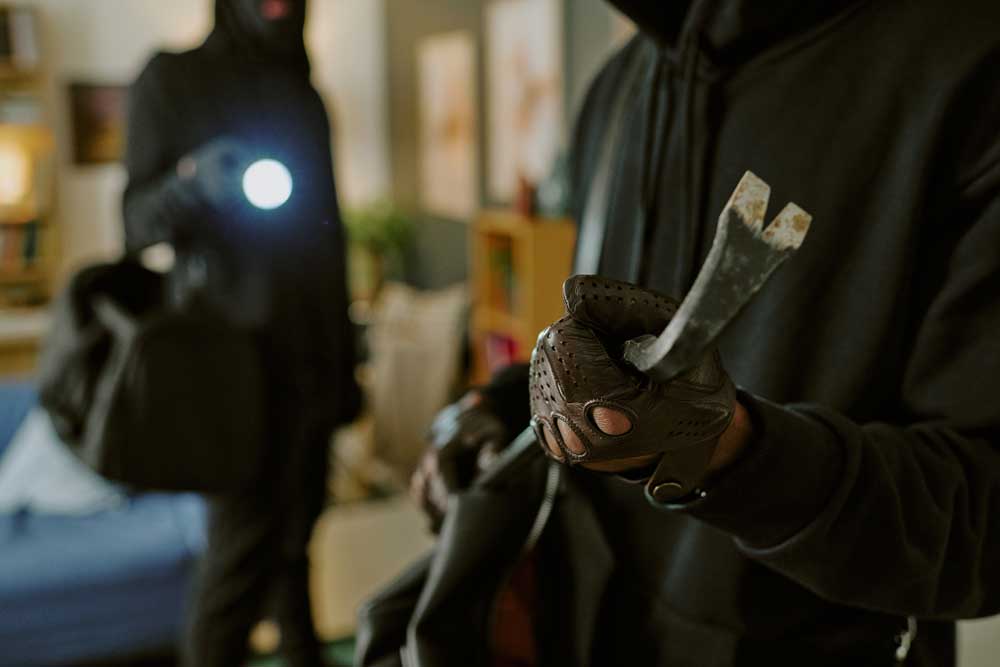
A realistic intrusion scenario illustrates the building’s vulnerabilities. An intruder begins by observing the entrance from the parking area, timing their approach to coincide with a resident’s entry. By following closely, the intruder tailgates through the main doors without needing to force entry. Once inside the hallway, they proceed unnoticed to the basement stairs, accessing storage areas. Here, they attempt to breach locks on individual compartments, potentially using tools like picks or pry bars to steal stored items such as bicycles or tools. This scenario exploits the lack of monitoring and access controls, allowing quick execution with minimal risk of detection. Such events are plausible in residential settings, where opportunists target unsecured basements (Fennelly, 2016). The model highlights how simple behavioural tactics can bypass current measures, emphasising the need for enhanced detection to interrupt such sequences.
Design of Technical Security Measures
To address identified risks, several technical measures are proposed. A camera surveillance system, installed at entrances, hallways, and basements, would provide real-time monitoring and recording, deterring potential intruders through visibility. A chip-based access control system for main doors would restrict entry to authorised residents, using RFID cards to log accesses and prevent tailgating. Motion sensors in basement areas could trigger alerts for unusual activity, integrated with lighting to enhance visibility. Additionally, upgrading to security doors with reinforced locks and materials would strengthen physical barriers. These measures contribute to a layered security approach, where detection complements prevention (Garcia, 2007). For instance, cameras not only deter but also aid investigations, while access systems ensure traceability, collectively reducing intrusion success rates.
Design of Regime Measures
Complementing technical solutions, regime measures involve procedural and behavioural changes. Residents could be encouraged to adopt habits like verifying visitors before allowing entry and reporting suspicious activity. Regular community meetings to discuss security protocols would foster awareness, while designating a resident security coordinator could oversee maintenance of measures. Locking basement access outside certain hours adds another control layer. These low-cost strategies enhance overall vigilance, aligning with community-based security models that emphasise human elements (Fennelly, 2016). By integrating regimes with technology, the building achieves a holistic defence, where residents actively participate in risk mitigation.
Economic Analysis of Proposed Measures
An orientational cost analysis is essential for feasibility. The camera system is estimated at 40,000 CZK, covering installation and basic units. The access control system approximates 35,000 CZK, including chips and readers. An alarm system adds 25,000 CZK, while security doors for key areas cost around 15,000 CZK per unit. Total initial costs sum to approximately 115,000 CZK, potentially shared among residents. This investment is justifiable given potential savings from prevented thefts, with costs benchmarked against market rates in the Czech Republic (Czech Statistical Office, 2021). Long-term, maintenance might add 10% annually, but benefits in reduced insurance premiums could offset this.
Possibility of Connection to Centralised Protection Desk
Connecting the building to a centralised protection desk (PCO) operated by a security agency offers advanced monitoring. This involves linking alarms and cameras to a 24/7 operations centre for immediate response. Advantages include rapid intervention by professional teams, enhancing deterrence through visible agency affiliation. Installation costs around 10,000 CZK, with monthly fees of 500 CZK, make it accessible. This setup provides higher security levels, particularly for vulnerable areas like basements, by ensuring professional oversight (Garcia, 2007). In Mladá Boleslav, local agencies could facilitate this, integrating with national standards.
Evaluation of Effectiveness of Proposed Measures
The proposed measures are evaluated for effectiveness using risk reduction criteria. Technical interventions like cameras and sensors directly address monitoring gaps, potentially reducing intrusion risks by 50-70% based on similar implementations (Fennelly, 2016). Regime measures enhance community resilience, while PCO integration ensures timely responses. Overall, these create a robust system, with effectiveness measured through reduced incident reports and resident feedback. Limitations include initial costs and maintenance needs, but the layered approach outweighs these, providing scalable security improvements.
Conclusion
This paper has identified key security risks in the Mladá Boleslav apartment building, such as uncontrolled access and unmonitored areas, through detailed analysis and a model scenario. Proposed technical measures, including cameras and access systems, alongside regime protocols, offer practical enhancements. Economic considerations confirm feasibility, with PCO integration adding value. Ultimately, these interventions significantly increase the building’s security, protecting residents and property. Implementing them could serve as a model for similar structures, demonstrating the applicability of security management principles in residential contexts.
References
- Czech Police. (2022) Annual Crime Statistics Report. Ministry of the Interior, Czech Republic.
- Czech Statistical Office. (2021) Housing and Urban Development in the Czech Republic. Housing and Urban Development in the Czech Republic. Czech Statistical Office.
- Fennelly, L. (2016) Effective Physical Security. 5th edn. Butterworth-Heinemann.
- Garcia, M.L. (2007) Design and Evaluation of Physical Protection Systems. 2nd edn. Butterworth-Heinemann.
(Word count: 1,248)

