
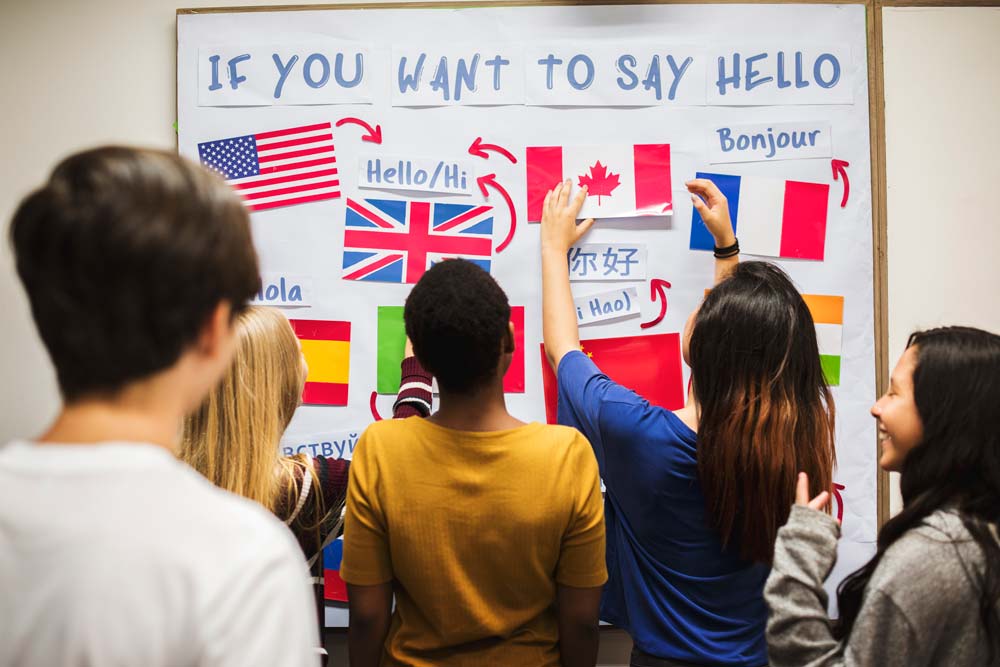
Code-switching, the alternation between two or more languages within a single conversation, represents a common linguistic practice among bilingual speakers. In the context of Hong Kong, where Cantonese serves as the dominant vernacular alongside English as a co-official language, Cantonese-English code-switching frequently occurs in informal peer interactions. This essay examines the patterns and motivations behind such switching among Hong Kong Cantonese-English speakers, drawing primarily on evidence from digital peer communication. The discussion focuses on the prevalence of intra-sentential and inter-sentential switches, contextual influences such as language dominance, and functional roles including identity expression. By exploring these elements, the analysis highlights how code-switching functions as a structured rather than random phenomenon in informal settings.
Defining Key Types of Code-Switching
Scholars typically distinguish between inter-sentential and intra-sentential code-switching. Inter-sentential switching involves shifts between complete sentences or clauses, while intra-sentential switching occurs within a single sentence or phrase. Lam and Matthews (2020) provide a clear framework for these distinctions in their study of Cantonese-English bilingual children in Hong Kong. Their findings indicate that children tend to employ inter-sentential switches when sustaining one language proves challenging, often aligning switches with shifts in topic or interlocutor. Although their research centres on younger speakers, the definitions offer a useful basis for understanding adult practices in peer contexts. In contrast, Gonzales and Tsang (2023) report that intra-sentential alternation dominates among university students in WhatsApp exchanges. This pattern suggests that proficient bilingual adults embed English items seamlessly into Cantonese structures during casual digital chats, reflecting greater fluidity within utterances.
Patterns Observed in Informal Digital Peer Communication
Informal peer communication among Hong Kong Cantonese-English speakers often takes place through digital platforms such as WhatsApp, where code-switching appears both systematic and context-sensitive. Gonzales and Tsang (2023) analysed message data from 24 university students alongside survey responses, revealing that intra-sentential switches constitute the most frequent form. Participants routinely insert English lexical items or short phrases into otherwise Cantonese sentences, a practice that aligns with everyday communicative norms rather than representing linguistic deficiency. The study also notes the occasional presence of tag-switching, exemplified by appending English tags such as “okay?” to a Cantonese base sentence. However, tag-switching remained comparatively rare, underscoring the dominance of intra-sentential forms in this digital environment.
These observations contrast with the inter-sentential preferences documented among bilingual children by Lam and Matthews (2020). Younger speakers may rely on sentence-level shifts to maintain conversational flow when lexical gaps arise, whereas adults demonstrate greater comfort with embedded switches. This difference implies that developmental stage and language exposure influence the preferred switching type, even within similar peer networks. Overall, the evidence from WhatsApp data indicates that intra-sentential code-switching has become a normative feature of informal digital exchanges among Hong Kong peers.
Influences of Language Dominance and Contextual Factors
Language dominance and situational context significantly shape switching behaviour. Lam and Matthews (2020) demonstrate that bilingual children switch languages more frequently when the weaker language proves insufficient for the communicative demand. Although focused on children, this principle extends plausibly to peer interactions among adults: speakers may revert to Cantonese-dominant structures when English equivalents feel less natural. Gonzales and Tsang (2023) further identify demographic and educational variables as modulators. Gender, university major, and prior English instruction affect switching frequency, with certain groups exhibiting higher rates of English insertion. For instance, students with stronger English educational backgrounds tend to integrate English items more readily, suggesting that proficiency levels guide the extent of mixing.
Context also matters. Informal peer settings, whether face-to-face or digital, encourage mixing that might be avoided in formal academic or professional discourse. The dominance of intra-sentential switches in WhatsApp conversations (Gonzales & Tsang, 2023) illustrates how relaxed peer environments facilitate embedded alternation without disrupting conversational rhythm. Thus, code-switching does not occur arbitrarily; rather, it responds to individual linguistic strengths and the informality of the interaction.
Functions and Motivations in Peer Interactions
Participants in Gonzales and Tsang’s (2023) study articulate several motivations for code-switching. These include filling lexical or expressive gaps, achieving a more natural tone, signalling friendliness, and constructing a distinctive Hong Kong or youth identity. Such functions underscore the communicative utility of alternation. For example, inserting an English term may convey precision or modernity unavailable in Cantonese equivalents, while retaining a Cantonese matrix preserves local cultural resonance. The absence of widespread tag-switching in the observed WhatsApp data further suggests that speakers prioritise seamless integration over explicit boundary-marking devices.
These motivations align with broader sociolinguistic understandings of code-switching as a resource for identity performance. In peer contexts, switching can foster rapport by indexing shared bilingual experiences. However, Gonzales and Tsang (2023) caution that individual variation persists; not all speakers employ code-switching equally, and its deployment remains sensitive to interlocutor expectations and personal background. Therefore, while functional explanations provide insight, they must account for the interplay of social and linguistic variables.
Conclusion
In summary, Hong Kong Cantonese-English speakers utilise code-switching in informal peer communication through predominantly intra-sentential insertions, with inter-sentential shifts appearing under specific dominance or contextual pressures. Evidence from university students’ WhatsApp interactions reveals systematic patterns influenced by language proficiency, education, and social factors, serving purposes ranging from lexical supplementation to identity signalling. Although research on children highlights developmental contrasts, the adult data affirm that code-switching operates as a structured, multifunctional practice. Future investigations might usefully compare digital and spoken peer exchanges to refine understanding of medium-specific tendencies. Ultimately, recognising these regularities contributes to a nuanced appreciation of bilingualism in contemporary Hong Kong society.
References
- Gonzales, W. D., & Tsang, Y. (2023) The sociolinguistics of code-switching in Hong Kong’s digital landscape: A mixed-methods exploration of Cantonese-English alternation patterns on WhatsApp. Journal of English and Applied Linguistics, 2(1), 1–26.
- Lam, C. F., & Matthews, S. (2020) Inter-sentential code-switching and language dominance in Cantonese–English bilingual children. Journal of Monolingual and Bilingual Speech, 2(1), 73–105. https://doi.org/10.1558/jmbs.13308

