
Introduction
Plato’s Symposium, a foundational text in ancient Greek philosophy, presents a series of speeches on the nature of love (Eros) delivered at a drinking party. As a student of classics and philosophy, I find certain aspects of this dialogue intriguing yet perplexing, particularly how Plato interweaves rational discourse with elements of chaos and intoxication. This essay examines a specific puzzle in the Symposium: why Plato, typically an advocate for reason, incorporates irrational and ecstatic disruptions into a philosophical exploration of love. To address this, I draw on Source A, Plato’s Symposium, and use Source B, a Greek bust of Dionysus’ head, to illuminate these themes. Dionysus, the god of wine and ecstasy, offers a lens to understand how such irrationality serves philosophical ends. The essay begins by outlining a preliminary understanding of the Symposium, identifies the puzzle, digresses to analyse the Dionysus bust with connections to the text, returns to explain how the bust resolves the puzzle, and explores broader implications. Through this, I aim to demonstrate that ecstasy and reason are not oppositional but complementary in Greek thought.
Preliminary Understanding of Plato’s Symposium
Plato’s Symposium, written around 385–370 BCE, is set at a banquet hosted by the poet Agathon, where guests including Socrates deliver encomia to Eros (Plato, 1993). The dialogue begins with the participants agreeing to forgo heavy drinking in favour of philosophical discussion, emphasising restraint and intellectual pursuit. Each speech builds on the last, progressing from physical to spiritual conceptions of love. For instance, Pausanias distinguishes between vulgar and heavenly Eros, while Aristophanes offers a mythological account of soulmates (Plato, 1993, 189c–193d). The climax is Socrates’ recounting of Diotima’s teachings, which describe love as a ladder ascending from bodily beauty to the contemplation of the Form of Beauty itself (Plato, 1993, 210a–212a). This framework aligns with Plato’s broader philosophy, where reason leads to truth, as seen in works like the Republic (Waterfield, 1993).
However, the dialogue is not purely rational. The setting itself—a symposium, or drinking party—evokes the cultural practice of symposia in ancient Greece, where wine facilitated social and intellectual exchange (Bremmer, 1997). Wine, associated with loosening inhibitions, hints at a tension between control and abandon. Indeed, the guests’ initial decision to drink moderately is subverted by the sudden arrival of Alcibiades, who enters drunk and disrupts the orderly speeches with a personal, intoxicated eulogy to Socrates (Plato, 1993, 212c–223b). This intrusion introduces chaos, humour, and raw emotion, contrasting the earlier disciplined discourse. As a student engaging with Greek philosophy, I appreciate how this structure reflects Plato’s dialectical method, where opposing views generate deeper insight. Yet, it raises questions about why Plato includes such elements in a text ostensibly promoting rational ascent.
The Puzzle in Plato’s Symposium
The puzzling aspect emerges in this blend of rationality and irrationality. Why does Plato, who often critiques sensory excesses in favour of intellectual purity, allow intoxication and disruption to infiltrate his philosophical narrative? In Diotima’s speech, love is portrayed as a philosophical midwife, birthing wisdom through disciplined contemplation (Plato, 1993, 206d–e). This seems at odds with Alcibiades’ drunken state, which embodies excess and unpredictability. Alcibiades compares Socrates to Silenus figures—ugly exteriors hiding divine wisdom—and recounts personal anecdotes of erotic pursuit, injecting passion and disorder (Plato, 1993, 221d–e). This could undermine the rational ideal, as intoxication typically impairs judgement, a point Plato critiques elsewhere, such as in the Laws where excessive drinking is regulated (Plato, 1960).
Furthermore, the dialogue ends without resolution; the party descends into revelry as more drunken guests arrive (Plato, 1993, 223b–d). This lack of closure puzzles me, as it contrasts with Plato’s emphasis on achieving transcendent knowledge. Scholars like Nussbaum (1986) note that the Symposium grapples with the limits of reason in understanding human desires, but the deliberate inclusion of chaos suggests Plato acknowledges irrational forces in philosophy. Is this a flaw, or does it point to a deeper integration of ecstasy in Greek thought? This puzzle—how irrational elements enhance rather than detract from philosophical inquiry—requires external insight to resolve.
Digression: An Account of the Dionysus Bust
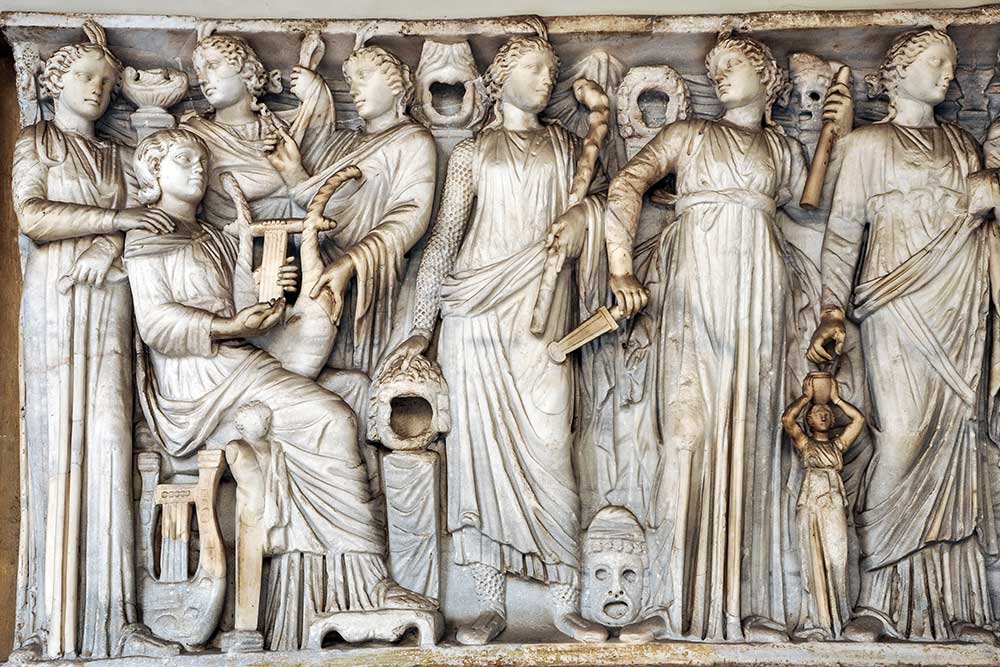
To address this puzzle, I turn to Source B: a Greek bust of Dionysus’ head, such as the Hellenistic example from the 2nd century BCE housed in the British Museum (British Museum, n.d.). This sculptural representation depicts Dionysus with youthful features, flowing hair often wreathed in ivy or grapes, and a serene yet enigmatic expression. In ancient Greek art, such busts symbolise Dionysus as the god of wine, theatre, and ecstatic rites, embodying transformation and liberation from rational constraints (Carpenter, 1997). The bust’s details—soft, effeminate curls and a gaze that suggests introspection amid revelry—connect to themes in the Symposium, where wine facilitates discourse and ecstasy mirrors erotic ascent.
Notably, similarities abound: the symposium setting invokes Dionysian rituals, as symposia were dedicated to Dionysus, with wine inducing altered states (Bremmer, 1997). The bust’s ivy crown evokes the maenads’ frenzy, paralleling Alcibiades’ disruptive energy. Moreover, Dionysus represents duality—civilised patron of arts yet wild instigator of madness—a motif in Greek culture where he bridges order and chaos (Otto, 1965). This duality is key; unlike purely rational deities like Apollo, Dionysus embodies enthousiasmos (divine possession), which Plato himself valorises in the Phaedrus as a form of madness essential for prophecy and love (Plato, 2005, 244a–245c).
The bust’s serene face, often interpreted as masking profound ecstasy, highlights the unlocking element: Dionysus illustrates how controlled irrationality can access higher truths. This concept, drawn from Dionysian iconography, suggests that intoxication is not mere disorder but a pathway to transcendence, much like the erotic madness in the Symposium. Thus, the bust provides a cultural analogue to resolve the puzzle.
Returning to the Symposium: How the Dionysus Bust Solves the Puzzle
Integrating insights from the Dionysus bust clarifies the puzzle in Plato’s Symposium. Dionysus, as depicted, embodies the harmonious interplay of reason and ecstasy, explaining why Plato incorporates irrational elements. In Greek culture, Dionysus was not antithetical to philosophy but integral to it; his festivals, like the Dionysia, combined theatre— a form of rational mimesis—with ritual ecstasy (Carpenter, 1997). Similarly, the Symposium‘s structure uses the symposium’s Dionysian context to show that love’s ascent requires ecstatic disruption. Alcibiades’ drunken entrance, far from undermining reason, reveals Socrates’ wisdom through raw, unfiltered truth, akin to Dionysian revelation (Nussbaum, 1986).
The bust’s duality solves this by illustrating how Dionysus integrates opposites: his calm exterior hides transformative power, much like how the Symposium‘s rational speeches culminate in ecstatic insights. Diotima’s ladder, for instance, involves mania (madness) to reach the divine, echoing Dionysian enthusiasm (Plato, 1993, 210e; Otto, 1965). Thus, Plato suggests philosophy needs irrational sparks to transcend mere logic, a point supported by the cultural reverence for Dionysus as a liberator from ego-bound rationality.
Implications of This Analysis
This analysis has broader implications for understanding Greek philosophy and culture. It highlights that Plato’s work is not rigidly rationalist but acknowledges the holistic human experience, where ecstasy complements reason—a precursor to later ideas like Nietzsche’s Apollonian-Dionysian dichotomy, though rooted in ancient sources (Nietzsche, 1999). For students of humanities, this underscores the interdisciplinary nature of classics, blending philosophy, art, and religion. Moreover, it reveals limitations in viewing Plato solely through a modern rational lens; Greek thought often embraced paradox, as seen in Dionysian art’s role in civic life (Bremmer, 1997). However, this interpretation has limits, as not all symposia were chaotic, and Plato’s portrayal may satirise excess (Waterfield, 1993). Nonetheless, it enriches our grasp of how cultural artefacts like the Dionysus bust illuminate textual puzzles, encouraging further exploration of ecstasy in philosophy.
Conclusion
In conclusion, this essay has unravelled the puzzle of irrationality in Plato’s Symposium by drawing on a Greek bust of Dionysus to reveal how ecstasy enhances philosophical inquiry. By outlining the Symposium‘s structure, identifying the tension between reason and chaos, analysing the bust’s Dionysian symbolism, and applying it to resolve the puzzle, I have shown that Plato integrates these elements to depict a fuller path to wisdom. The larger implications extend to appreciating the dynamic interplay of order and abandon in Greek culture, challenging simplistic views of ancient philosophy. This approach not only deepens understanding of Plato but also demonstrates the value of cross-referencing texts with artefacts in humanities studies, potentially informing contemporary discussions on emotion and rationality.
References
- Bremmer, J. N. (1997) ‘The Greek symposium and the role of wine’, in Murray, O. and Tecuşan, M. (eds.) In vino veritas. London: British School at Rome, pp. 31-45.
- British Museum (n.d.) Marble head of Dionysos. The British Museum.
- Carpenter, T. H. (1997) Dionysian imagery in fifth-century Athens. Oxford: Clarendon Press.
- Nietzsche, F. (1999) The birth of tragedy. Translated by R. Speirs. Cambridge: Cambridge University Press. (Original work published 1872)
- Nussbaum, M. C. (1986) The fragility of goodness: Luck and ethics in Greek tragedy and philosophy. Cambridge: Cambridge University Press.
- Otto, W. F. (1965) Dionysus: Myth and cult. Translated by R. B. Palmer. Bloomington: Indiana University Press. (Original work published 1933)
- Plato (1960) Laws. Translated by R. G. Bury. Cambridge, MA: Harvard University Press.
- Plato (1993) Symposium. Translated by R. Waterfield. Oxford: Oxford University Press.
- Plato (2005) Phaedrus. Translated by C. Rowe. London: Penguin Classics.
- Waterfield, R. (1993) Introduction to Plato’s Republic. Oxford: Oxford University Press.

