
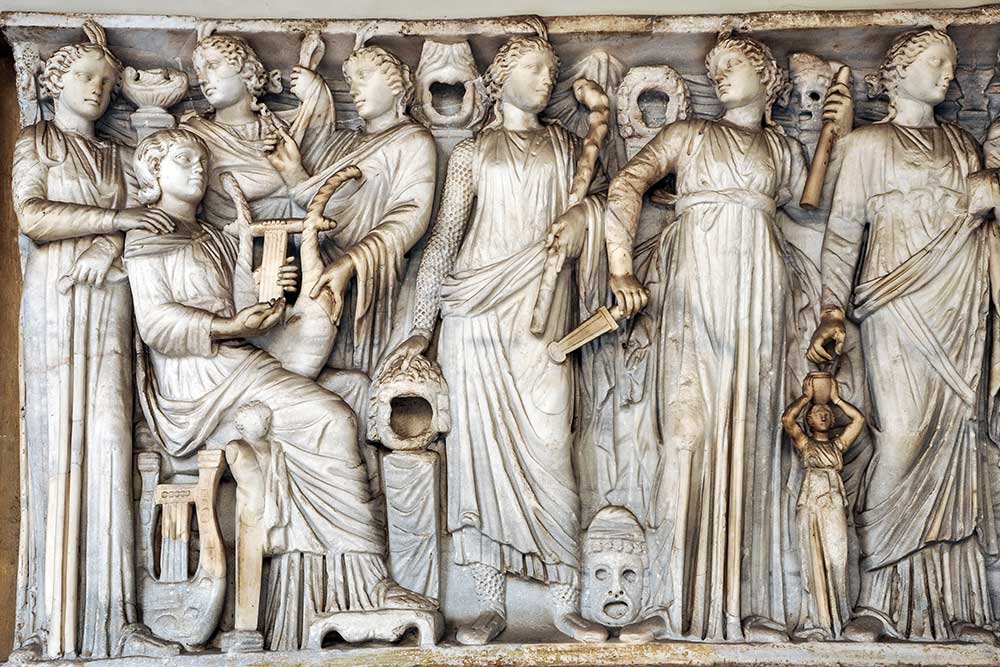
Civilizational Achievements of Ancient Rome
Introduction Ancient Rome, spanning from its legendary founding in 753 BCE to the fall of the Western Empire in 476 CE, represents one of ...
How is Gilgamesh’s fear of death represented in the story – as obsession, weakness, wisdom, strength, caution, necessity, or something else?
Introduction In the context of Humanity 111, which explores ancient narratives and their insights into the human condition, The Epic of Gilgamesh offers a ...
Gouverner avec les dieux à Rome, IIIeme siècle avant J.-C. à IIIeme siècle après J.C.
Introduction The interplay between religion and governance in ancient Rome, from the 3rd century BC to the 3rd century AD, reveals a profound integration ...
Students should expect to consult a minimum of 6 scholarly studies to develop their understanding of the chosen source, its historical context and evidentiary value. Claudius and Britannia, with inscribed base. Sebasteion, south building https://aphrodisias-excavations.com/sebasteion-reliefs/
Introduction The relief depicting Emperor Claudius subduing Britannia, located in the Sebasteion complex at Aphrodisias in modern-day Turkey, serves as a significant artefact from ...
Exploring the Puzzle of Hedonism and True Love in Plato’s Symposium: Insights from Dionysian Iconography
Introduction Plato’s Symposium, a cornerstone of ancient Greek philosophy, presents a dialogue on the nature of love (eros) set against the backdrop of a ...
Exploring the Puzzle of Irrationality in Plato’s Symposium: Insights from a Greek Bust of Dionysus
Introduction Plato’s Symposium, a foundational text in ancient Greek philosophy, presents a series of speeches on the nature of love (Eros) delivered at a ...
Tacitus is not interested in women as historical agents; he uses them only as literary devices to explore male power, morality, and the decline of the principate. To what extent is this statement true? Discuss with a detailed reference with three different female characters from the Annals.
Introduction Tacitus, the Roman historian writing in the early second century CE, is renowned for his Annals, a work that chronicles the history of ...
Recognition Scenes in the Odyssey
Introduction Homer’s Odyssey, an epic poem from ancient Greece dating to around the 8th century BCE, stands as a cornerstone of Western literature, particularly ...
Tacitus is not Interested in Women as Historical Agents: He Uses Them as Literary Devices to Explore Male Power, Morality, and the Decline of the Principate. To What Extent is this Statement True? Discuss with Detailed Reference to Three Different Female Characters from the Annals
Introduction Tacitus’ Annals, a cornerstone of Roman historiography, provides a detailed account of the Julio-Claudian emperors from Tiberius to Nero, spanning the early Principate. ...
Tacitus is not interested in women as historical agents; he uses them only as literary devices to explore male power, morality, and the decline of the principate. To what extent is this statement true? Discuss with a detailed reference with three different female characters from the Annals
Introduction Tacitus’ Annals, a key work of Roman historiography, chronicles the history of the Roman Empire from the death of Augustus in 14 CE ...
